This is where Business Intelligence (BI) consulting can make a game-changing difference. In this case study, we’ll explore how MetroMart, a mid-sized retail chain, partnered with a BI consulting firm to increase its annual revenue by 18% in just 12 months.
We’ll break down:
The challenges MetroMart faced
The BI consulting approach
The integration of Power BI and other tools
Key results and ROI
Lessons that can be applied to any retail business
The Background: MetroMart’s Position in the Market
MetroMart operated 42 brick-and-mortar stores across three states and had a growing eCommerce platform. While sales were steady, growth had plateaued for the last three years.
Key facts before BI consulting intervention:
Annual revenue: $120M
eCommerce share: 18% of total sales
Average monthly footfall decline: 3% year-over-year
Customer churn rate: 24% annually
Data spread across: ERP, POS systems, CRM, inventory management, and eCommerce platform
The leadership team knew they were making important decisions based on incomplete or outdated data. Marketing campaigns weren’t targeted, inventory management was reactive rather than proactive, and store managers lacked real-time performance visibility.
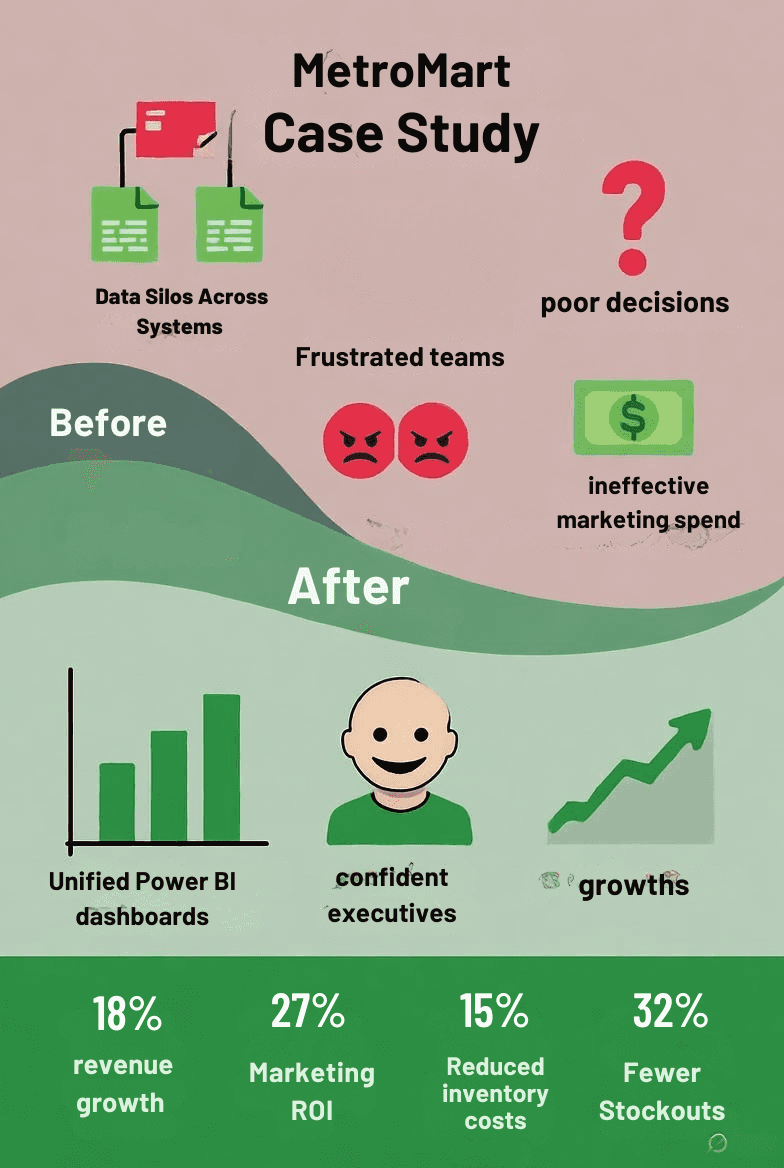
The Challenges
1. Data Silos Across Systems
Sales data lived in the POS system, inventory was tracked in a separate ERP, customer loyalty data in a CRM, and online transactions in the eCommerce backend. No single view existed.
2. Poor Inventory Forecasting
Some stores faced overstock situations leading to markdown losses, while others frequently ran out of high-demand items.
3. Ineffective Marketing Spend
Marketing campaigns were designed based on gut feel and generic demographics, not actual behavioral insights.
4. Limited Performance Visibility for Managers
Store managers could only access monthly performance reports — too late to act on real-time trends.
The BI Consulting Approach
The retail chain engaged ABC Consulting, a BI firm specializing in retail analytics with a strong focus on Microsoft Power BI integrations.
Step 1: Discovery & Data Audit
The consulting team conducted a 4-week audit of MetroMart’s systems. They assessed:
Data sources and formats
Data quality and completeness
Business KPIs currently being tracked
Stakeholder decision-making workflows
They discovered 14 different data sources and inconsistencies in SKU naming conventions between the ERP and eCommerce platform.
Step 2: Data Integration & Warehousing
ABC implemented a cloud-based data warehouse to unify data streams from:
POS terminals
ERP system (SAP Business One)
CRM (Salesforce)
eCommerce backend (Shopify)
Marketing automation tool (HubSpot)
Data was cleaned, deduplicated, and standardized. Historical data for the last 5 years was migrated to enable trend analysis.
Step 3: Power BI Dashboard Development
The consulting team built role-based Power BI dashboards:
For Executives:
Company-wide sales trends
Revenue by region, channel, and category
Profitability analysis
Customer acquisition vs. retention metrics
For Store Managers:
Real-time daily sales against targets
Inventory alerts for low or excess stock
Staff performance metrics
Footfall vs. conversion rate analysis
For Marketing Team:
Campaign ROI analysis
Customer segmentation by purchase behavior
Cross-sell and upsell opportunity identification
Step 4: Advanced Analytics Integration
They embedded predictive analytics models into Power BI to forecast:
Demand for key SKUs during seasonal periods
Store-level foot traffic based on historical patterns and external factors like weather
Likelihood of customer churn
Step 5: Training & Change Management
A major part of BI consulting success comes from adoption. ABC Consulting conducted:
6 on-site training workshops
“Dashboard champion” program — one power user per store trained deeply to support others
Weekly Q&A sessions during the first 90 days post-launch
The Results
Within 12 months of implementing BI consulting solutions, MetroMart saw:
Revenue growth: +18% year-over-year
Marketing ROI: +27% improvement by reallocating budget to high-yield customer segments
Inventory carrying costs: Reduced by 15% through better forecasting
Stockouts: Down by 32%, improving customer satisfaction
Churn rate: Dropped from 24% to 18% due to targeted loyalty campaigns
ROI Analysis
The total BI consulting project cost $320,000 over 8 months (including software, consulting, training, and integration). The first-year revenue uplift of $21.6M and cost savings of $2.4M from reduced markdowns and better inventory meant a payback period of less than 3 months.
Lessons for Other Retailers
1. Data integration is non-negotiable. Without a unified view, decisions will always be reactive.
2. Dashboards must be role-specific. Store managers don’t need the same KPIs as executives.
3. Predictive analytics can turn inventory from a cost center into a revenue driver.
4. Change management ensures adoption. Tools are only as effective as the people using them.
MetroMart’s journey shows that BI consulting, when done right, is not just about dashboards — it’s about creating a data-driven decision-making culture that directly impacts the bottom line. For businesses looking to improve profitability, integrating Power BI with a robust data strategy is one of the smartest moves they can make in 2025 and beyond.