From AI-powered analytics to augmented decision-making and cloud-native BI architectures, the trends shaping BI this year are setting the tone for the decade ahead. And for enterprises, the stakes are high: harnessing these innovations could mean competitive advantage; ignoring them could mean falling behind.
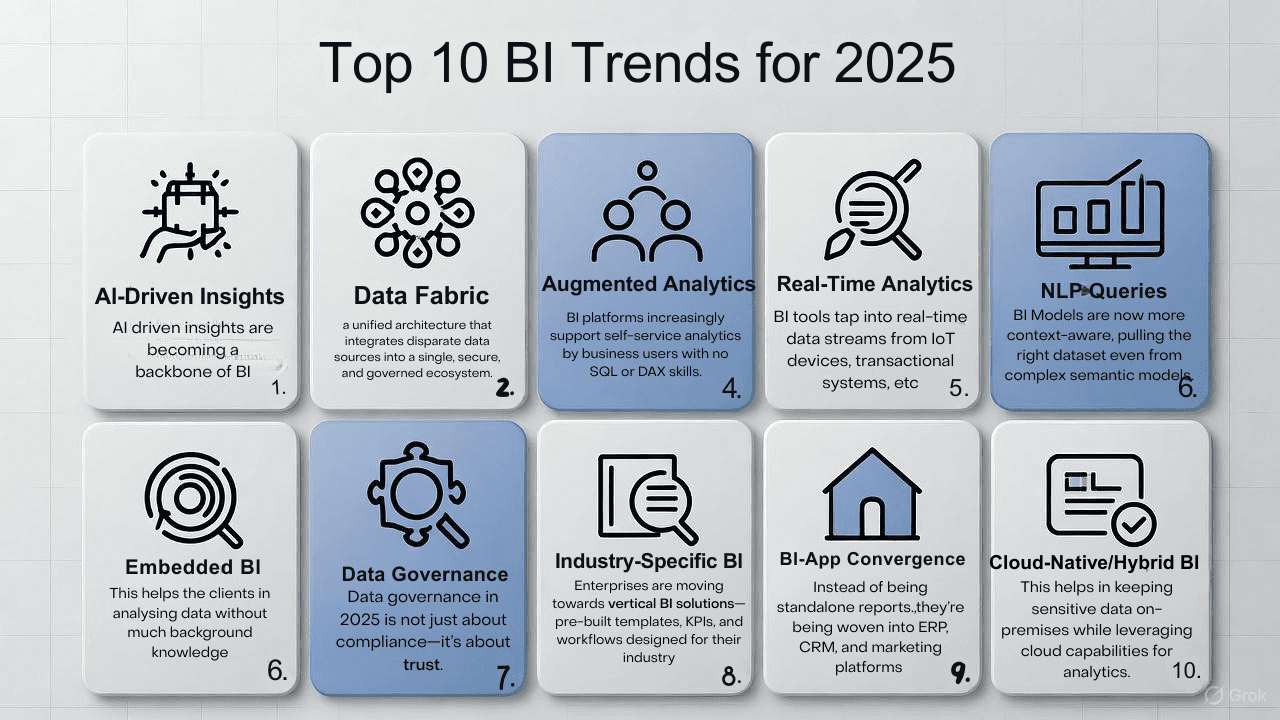
1. AI-Driven Insights Become Mainstream
Artificial Intelligence is no longer an optional add-on in BI—it’s becoming a core capability.
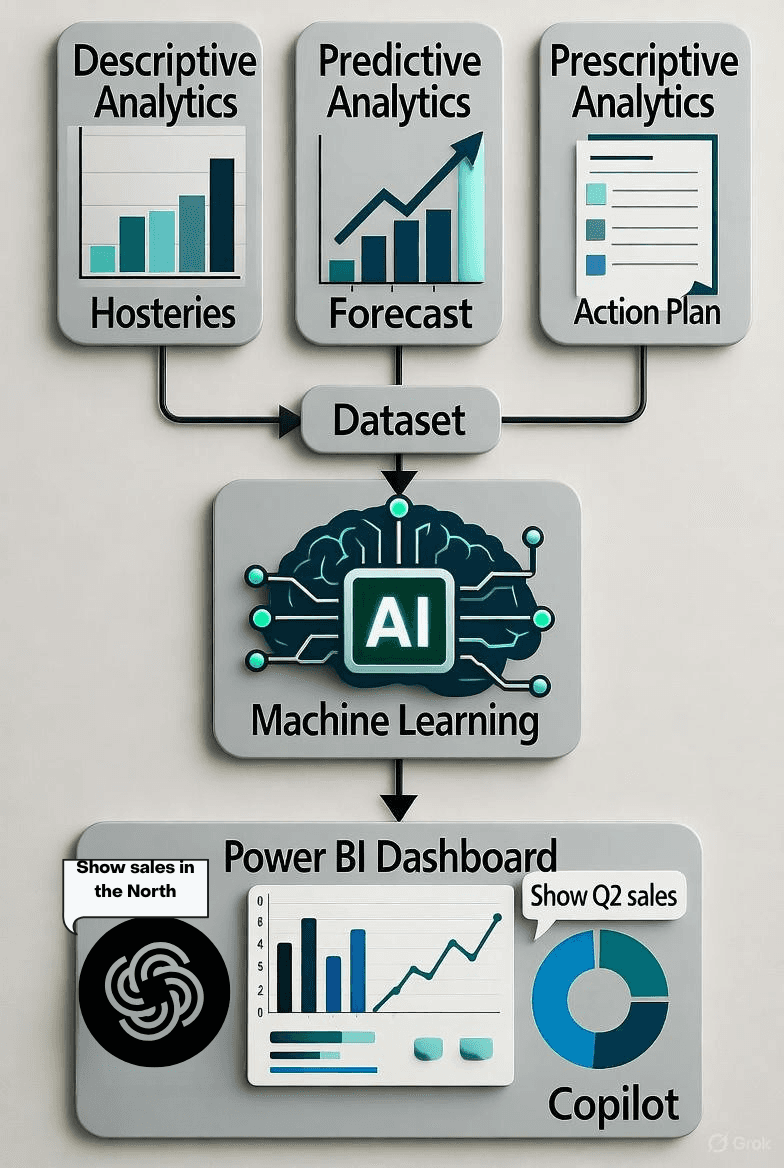
Enterprises are leveraging machine learning algorithms to go beyond descriptive analytics (“what happened”) into predictive (“what will happen”) and prescriptive (“what should we do next”) territory.
Key examples in 2025:
Power BI’s integration with Microsoft Fabric and Copilot allows analysts to generate insights and even write DAX queries using natural language.
Predictive sales forecasting embedded directly in CRM-integrated dashboards.
Automated anomaly detection for financial fraud monitoring.
If you’ve read our earlier piece on AI, Fabric, and Augmented Analytics you’ll notice the same shift here: AI is no longer siloed—it’s embedded into the BI workflow, helping decision-makers act faster.
2. Enterprise-Wide Data Fabric Architectures
The days of fragmented, department-level BI systems are fading. In 2025, enterprises are investing in data fabric—a unified architecture that integrates disparate data sources (ERP, CRM, IoT, ****marketing automation tools, etc.) into a single, secure, and governed ecosystem.
Why this matters:
Faster time to insights by eliminating data silos.
Consistent KPIs across the organization.
Reduced IT overhead with centralized governance.
3. Augmented Analytics for Non-Technical Users
BI platforms increasingly support self-service analytics by business users with no SQL or DAX skills.
Augmented analytics uses AI to:
Suggest relevant visuals.
Highlight outliers automatically.
Generate narratives alongside charts.
For example, a marketing manager using Power BI for Marketing Analytics can have campaign performance summaries generated instantly, without waiting for the analytics team.
4. Real-Time Analytics for Immediate Decision-Making
In fast-moving industries like logistics, finance, and retail, waiting for end-of-day reports is no longer an option.
Enter streaming analytics, where BI tools tap into real-time data streams from IoT devices, transactional systems, and APIs.
Benefits for enterprises:
Real-time supply chain monitoring.
Dynamic pricing updates.
Instant fraud detection alerts.
We explored a similar capability when discussing Data Integration vs Data Warehousing—while warehousing handles historical data, integration is key to enabling real-time flows.
5. Natural Language Processing (NLP) in BI Queries
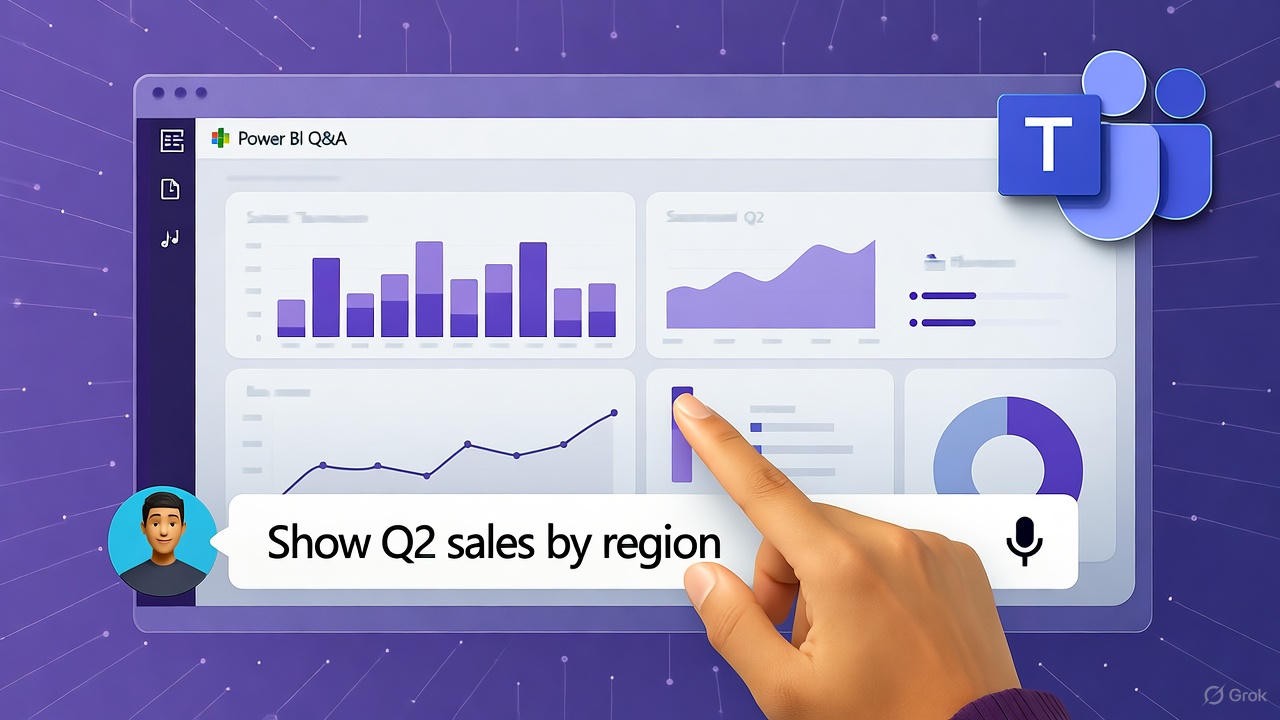
NLP is revolutionizing the way enterprise users engage with data. They don't need to write sophisticated queries anymore. Instead, they type or say:
“Show me Q2 sales performance by region compared to last year.”
In 2025:
Power BI Q&A is now more context-aware, pulling the right dataset even from complex semantic models.
Voice-activated analytics assistants are emerging within enterprise chat platforms like Microsoft Teams.
6. Embedded BI for Client-Facing Applications
More enterprises are embedding BI dashboards directly into customer portals and B2B SaaS platforms.
Use cases:
SaaS platforms providing clients with custom analytics.
Manufacturers offering dealers a portal with real-time order tracking and sales trends.
Financial services apps with embedded personal investment dashboards.
7. Stronger Focus on Data Governance and Compliance
With growing regulations such as GDPR, CCPA, and emerging AI rule-making laws, businesses can't tolerate sloppy data habits.
Data governance in 2025 is not just about compliance—it’s about trust.
Best practices:
Row-level security in Power BI to control access at a granular level.
Automated data lineage tracking for audit trails.
Integration with enterprise identity and access management tools.
For a deeper dive into this, our Data Governance in Power BI article breaks down the key strategies for enterprise-grade compliance.
8. Industry-Specific BI Solutions
Enterprises are moving towards vertical BI solutions—pre-built templates, KPIs, and workflows designed for their industry.
Examples:
Healthcare BI dashboards with HIPAA-compliant reporting.
Retail BI with automated inventory replenishment alerts.
Manufacturing BI with predictive maintenance insights from IoT sensors.
9. Convergence of BI and Business Applications
BI tools are no longer standalone reporting systems—they’re being woven into ERP, CRM, and marketing platforms so users can act on insights without leaving their workspace.
Example:
A sales manager gets a low-lead-volume alert in Power BI, and with one click, launches a marketing automation workflow in Dynamics 365.
10. Cloud-Native and Hybrid BI Deployments
The majority of enterprises are shifting BI workloads to the cloud for scalability and cost efficiency. However, some industries (like finance and defense) are opting for hybrid models to keep sensitive data on-premises while leveraging cloud capabilities for analytics.
Cloud-native benefits:
Automatic scaling for large datasets.
Lower upfront infrastructure costs.
Faster feature adoption from BI vendors.
All the BI trends in 2025 all signal towards enabling businesses with quicker, wiser, and more connected insights. The intersection of AI, data fabric, and self-service analytics equates to BI no longer being a specialist's tool—it's turning into a company-wide intelligence layer.